
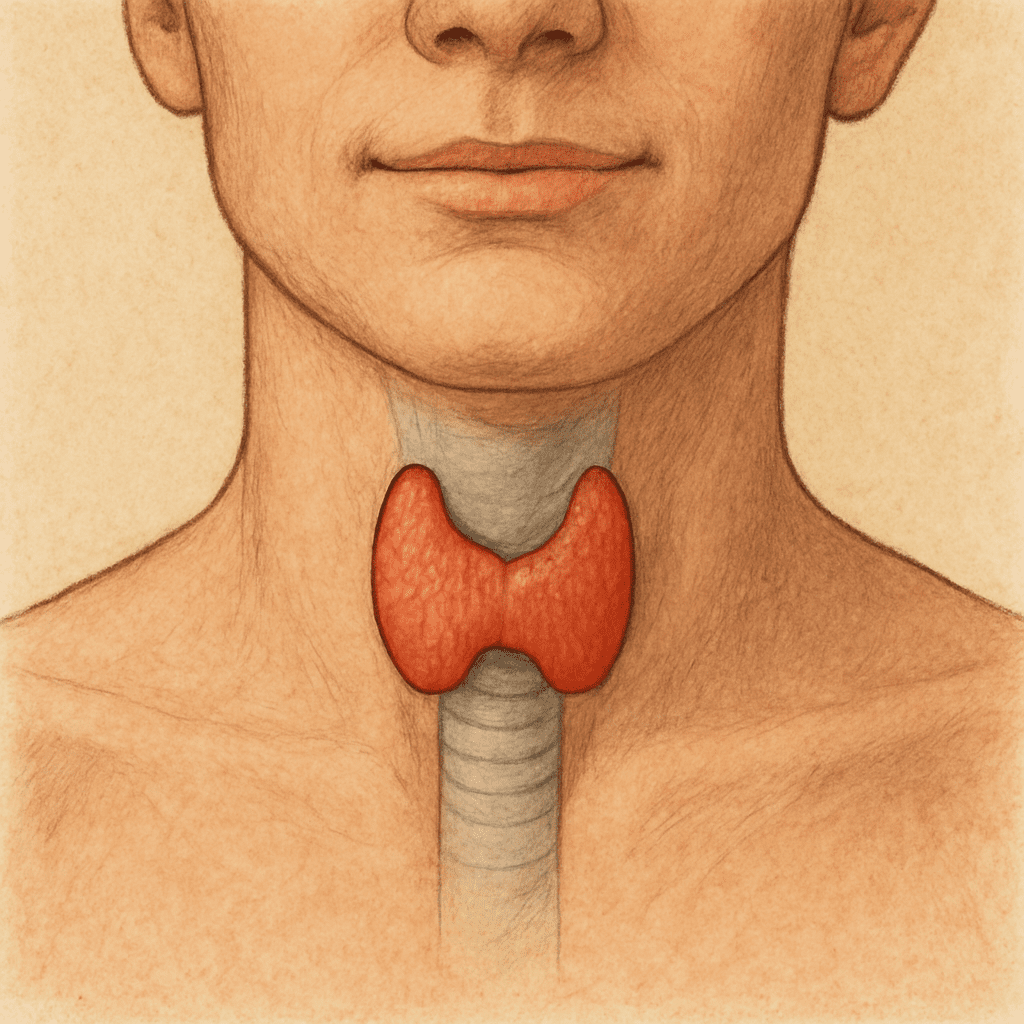
Imagine your body has an invisible thermostat located just below your Adam's apple. According to medical consensus, this small, butterfly-shaped organ is the central power station of your metabolism. It regulates every organ system, deciding whether your internal engine runs at full throttle or sputters with the brakes on.
Do you often feel inexplicably exhausted or notice diffuse thyroid symptoms? In medical practice, such signals are often mistakenly dismissed as mere stress. However, since this regulator controls everything from heartbeat to digestion, general malaise is a valid reason to have possible thyroid conditions checked. Your physical sensations are real and by no means just in your head.
Brain vs. Butterfly: How the „Manager“ (TSH) Communicates with the „Worker“ (T3/T4)
Let's consider the brain as the manager and the thyroid as the worker. On your blood test, you see exactly this conversation. The connection between T3, T4, and TSH is crucial for correctly interpreting lab values:
- TSH (The Shout) The brain is demanding more output from the thyroid gland.
- T4 (The Camp): The thyroid gland secretes this storage hormone in reserve.
- T3 (The Energy): The active hormone that directly drives your body.
Patients often worry about when their TSH level is too high and what that actually means. The logic behind it is simple: if the worker goes on strike, the manager has to shout louder. So, paradoxically, a high TSH level indicates that your thyroid is not working enough. If the active messengers are missing, your entire metabolism slows down.
Driving with the Parking Brake On: Recognizing Hypothyroidism and Hashimoto's
Does your daily life feel like you're driving with the emergency brake on? That's exactly what happens with hypothyroidism. Because your thyroid lacks power, your entire metabolism runs on low power. To recognize the early symptoms of hypothyroidism, you should watch out for these five often hidden warning signs:
- Persistent exhaustion (even after sufficient sleep)
- Unexplained weight gain despite same diet
- Constant chills, even in warm rooms
- Hair loss and noticeably dry skin
- „Brain fog and sudden forgetfulness
The most common cause of this chronic lack of energy is a malfunction of the body's immune system: In Hashimoto's thyroiditis, the body's own immune system mistakenly attacks the thyroid tissue. In addition to medical treatment, simple dietary tips for Hashimoto's thyroiditis – such as more anti-inflammatory omega-3 fatty acids and less industrial sugar – can often noticeably improve your quality of life.
When the engine overrevs: Symptoms and help for hyperthyroidism and Graves' disease
If your inner engine is running in the red zone while you're actually relaxing on the sofa, this indicates an overactive thyroid. Typical signs of an overactive thyroid (hyperthyroidism) include sudden heart palpitations, unexplained weight loss, and a deep inner restlessness that is often mistaken for everyday panic or stress.
A common cause of this is the autoimmune disease Graves' disease. In this condition, antibodies not only attack the thyroid gland but also often cause the tissue behind the eyes to swell. This eye involvement in Graves' disease then leads to a noticeably protruding, staring gaze.

To calm your metabolism again, the treatment of hyperthyroidism generally relies on three proven pillars:
- Medications So-called thyrostatics directly slow down the excessive hormone production.
- Radioiodine therapy A special capsule specifically and gently shrinks the overactive tissue.
- Operation: Surgical removal, if the gland is significantly enlarged.
Lumps, Swellings, and Scans: Correctly Interpreting „Warm“ vs. „Cold“ Nodules
Often, it's not the function but the mere form that causes concern. Iodine deficiency is one of the most common causes of an enlarged thyroid gland (known as a goiter). Over time, nodules can form within it, and doctors distinguish between warm and cold nodules.
Warm nodules act like little „workaholics“ that produce hormones completely uncontrollably and drive the pulse. Cold nodules, on the other hand, go on strike and no longer work. Both are usually harmless but must be clarified precisely for safety.
To make these tissue changes visible, a special camera is helpful. For this routine scan, the procedure and risks of scintigraphy are very manageable:
- Preparation: A painless ultrasound shows the exact structure beforehand.
- Gabe: You will be injected with a weakly radioactive substance that imitates iodine.
- Recording A camera takes relaxed photos as your body absorbs the fabric.
- Evaluation In the picture, active nodes light up brightly, while inactive ones remain dark.
The Path to Diagnosis: What to Expect at the Endocrinologist
When you visit a specialist for the first time, the examination process at the endocrinologist is usually surprisingly relaxed. First, the doctor gently palpates your neck to detect any preliminary hardening or swelling. However, since feeling alone only tells half the story, a painless sonography follows. This ultrasound makes the tissue visible on the screen as a detailed map, completely risk-free, using a cool gel.
However, images alone do not show how well your hormone factory is working, which is why a blood analysis is always necessary. Actively ask your doctor if, in addition to the TSH value, the free thyroid hormones are also tested – simple standard tests often look deceptively „normal“ even though you feel exhausted. Only this combination brings absolute clarity.

Small Organ, Big Influence: Hair Loss, Desire for Children, and Correct L-Thyroxine Intake
Does looking in the mirror reveal thinning hair? Often, hormonal imbalance is the cause of hair loss, as the thyroid gland directly controls cell growth. Sometimes, it's enough to balance out a slight iodine deficiency through food – such as by regularly consuming saltwater fish.
An unmet desire for children due to thyroid problems is also a common topic, as the embryo is completely dependent on maternal hormones initially. Doctors aim for particularly strict TSH target values here (often around 1.0). The „manager“ in the brain must not call out too loudly so that ideal pregnancy conditions prevail.
For the replacement hormones to be well absorbed into the blood (bioavailability), your morning routine is crucial. To avoid annoying errors when taking L-thyroxine, four simple rules apply:
- Take at least 30 minutes before breakfast.
- Swallow with tap water only.
- Forego coffee during this waiting period.
- Take iron tablets four hours later.
Finding Your Rhythm Again: Your Plan for a Balanced Life
You now understand your body's signals and no longer need to fear „hormonal Chinese.“ Use this knowledge directly for your next doctor's visit: note your specific symptoms and discuss them in a targeted manner. Whether it's for daily tablet adjustments or important follow-up care after thyroid surgery – you now have the tools to actively and confidently shape your treatment.
Your diagnosis is not the end of your quality of life, but the starting point to recalibrate your inner thermostat. Patience is your best companion in this process. Ultimately, the most important measuring instrument is not perfect lab values, but a clear goal: to feel like yourself again.
